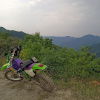
I acquired a 96 kdx 200 about 3 months ago and have been going through the neglect of the previous owner getting it running. Got to a good point I thought and did a camping/riding trip to Fort Sage OHV near Doyle CA and the bike was phenomenal, super fun and very capable. Put it in the garage for about 3 weeks then decided to go on a little ride last weekend and was having a bog from idle to a little over 1/4 throttle. Almost like I needed to downshift. Thought it was elevation/jetting related since I was going from about 5000 ft to 8300 ft. Got back home and realized heavy smoke from the exhaust and I'm pretty certain it's pulling transmission oil through the crank seal
Since splitting cases is the way to tackle this, what should be ok my list of things to replace while I'm there? I would like to not have to worry about anything other than regular maintenance for a bit. Thinking might as well do top end too.
So far I have this stuff on the list:
-crank bearings
-tusk engine oil seal kit
-inner clutch cover gasket
-tusk/wiseco pro-lite piston and gasket kit
-tusk clutch kit with heavy duty springs
A vacuum test just pulls a vacuum in the engine instead of applying pressure to it. Some seals only spring a leak one way with pressure or vacuum, so only doing one test can be inconclusive. Since the engine has periods of vacuum and pressure in the crankcase while it's running, it's best to test them both.
Now, you don't actually need an expensive setup to do this, I made one from a handheld vacuum and pressure pump for bleeding brakes.
Something like this:
(My amazon link is not working, at least not for me, so I attached a photo)
And then I used an adapter from my compression tester to connect the hose to the spark plug hole. If your adapter has one, remove the schrader valve stem.
When you have that together, make sure you put the piston at bottom dead center so the pressure and vacuum can get past the piston and enter the rest of the case, and plug the exhaust and intake. Also, I've read you don't want to pull more than 7 inHg (vacuum) on the cases. I've pulled more in the past, but I stick to 7 now. And no more than 5 psi of pressure.
I ended up making this specifically for the KDX as removing the airbox on it, or at least the E series, takes more work than I'd like if I'm just testing. I had made a another that goes in the intake for my 125 that works just fine as well.
Attachments
Screenshot_20260506-095855.png (1.1 MiB) Viewed 357 times
'92 KDX200
'25 CRF300L Rally
'05 CR125R
~Don't mind me, I can be a little slow
SpruceItUp wrote: 08:57 am May 06 2026
A vacuum test just pulls a vacuum in the engine instead of applying pressure to it. Some seals only spring a leak one way with pressure or vacuum, so only doing one test can be inconclusive. Since the engine has periods of vacuum and pressure in the crankcase while it's running, it's best to test them both.
Now, you don't actually need an expensive setup to do this, I made one from a handheld vacuum and pressure pump for bleeding brakes.
Something like this:
(My amazon link is not working, at least not for me, so I attached a photo)
And then I used an adapter from my compression tester to connect the hose to the spark plug hole. If your adapter has one, remove the schrader valve stem.
When you have that together, make sure you put the piston at bottom dead center so the pressure and vacuum can get past the piston and enter the rest of the case, and plug the exhaust and intake. Also, I've read you don't want to pull more than 7 inHg (vacuum) on the cases. I've pulled more in the past, but I stick to 7 now. And no more than 5 psi of pressure.
I ended up making this specifically for the KDX as removing the airbox on it, or at least the E series, takes more work than I'd like if I'm just testing. I had made a another that goes in the intake for my 125 that works just fine as well.
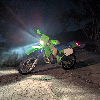
Thankyou! I will get that vacuum pump on the way and see what we are looking like. I did a leak down and compression test(135psi)when I first got it and it passed but I'm wondering if it is more likely to leak the other way like your saying. The bike sat for a long time after being rode hard. Got to a spot were it was running good and now this thought it was a little too good to be true just tossing it together and getting the jetting set up right haha
Hopefully have some numbers this weekend on the tests. Thanks for the help.
135psi is a bit on the low side, I would say it's time for at least to top end refresh and inspection, but only after doing a leak down test as the other members have stated, to determine the condition of the bottom end seals.
Also, I would strongly advise against using a Tusk seal kit. Use OEM or equivalent name brand seals, not a generic low-cost aftermarket kit, same with engine bearings.
As for the top end kit, I would recommend Wossner forged pistons over Wiseco every time, but also, OEM 200 pistons are great, especially if you ride in cold or high elevation areas and go back and forth in elevation and temperature often. Cast pistons are better for colder temperatures or drastic elevation changes with temperature change.
OEM or Cometic on the gasket kits. Cometic does not stock their own gaskets (everything is made to order if you order direct from them), but distributors do. Cometic will also custom make any gasket on the bike for you out of any material and any thickness requested that is non-stock. The MLS head gaskets are much preferred over the CFM 20 composite gaskets with a steel fire ring. I never like to use the steel fire rings on aluminum heads or cylinders only Multi-Layer Steel.








 thought it was a little too good to be true just tossing it together and getting the jetting set up right haha